Zodiac Compatibility: The Best and Worst Matches for Every Sign
· By Jag Mallah, Vedic astrologer · Analysis of Karma
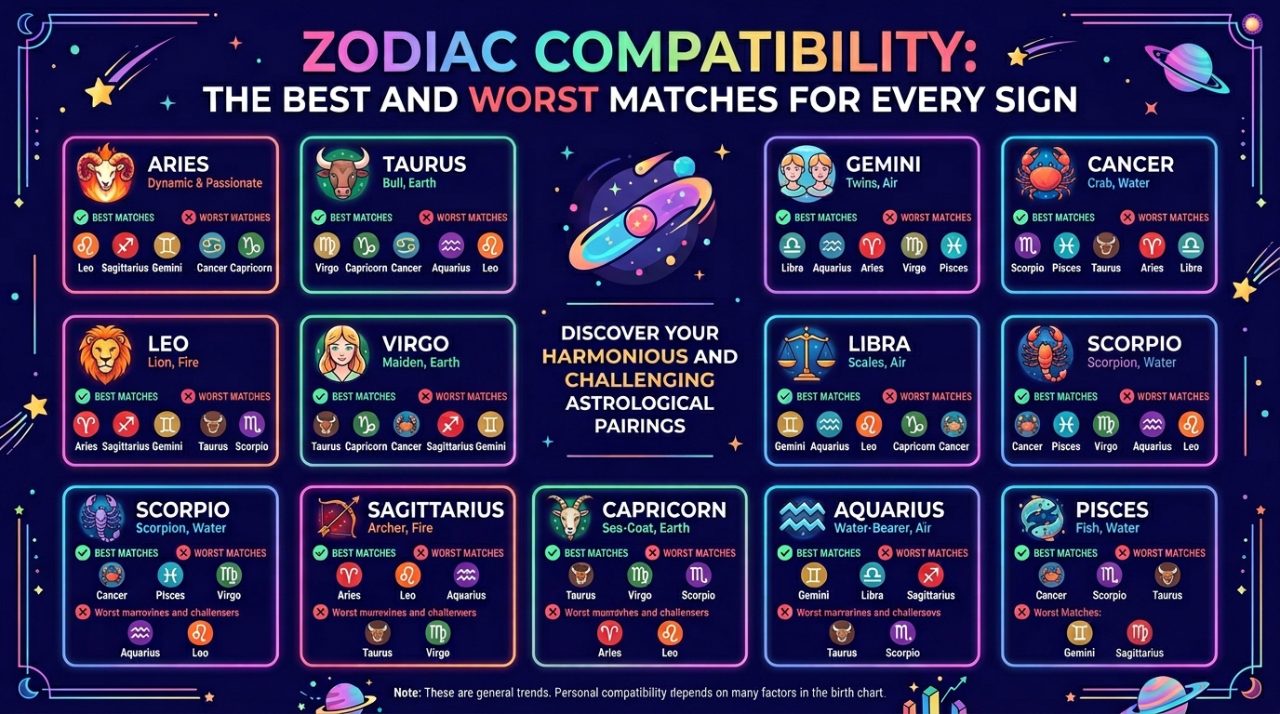
Zodiac compatibility is the most-searched question in astrology, and the simplest answer starts with the elements. Fire signs (Aries, Leo, Sagittarius) bring passion and drive. Earth signs (Taurus, Virgo, Capricorn) bring stability. Air signs (Gemini, Libra, Aquarius) bring ideas and communication. Water signs (Cancer, Scorpio, Pisces) bring emotion and depth.
As a rule of thumb, signs of the same element flow easily, and complementary elements — fire with air, earth with water — tend to support one another. The classically “challenging” pairs sit at a square to each other, where styles can grate. But challenge is not doom; friction often creates the most growth.
Here is the honest truth: sun-sign compatibility is a fun starting point, not a verdict. Real compatibility comes from synastry — comparing two full birth charts, including the Moon, Venus, Mars and the Ascendant. In Vedic astrology, Guna Milan and Mangal Dosha analysis go deeper still. If a relationship matters to you, a proper matching reading will tell you far more than your Sun signs alone.
Classical Foundations in Jyotish
From Sun signs to Moon signs
Popular compatibility lists compare Sun signs. Jyotish compares the Moon signs (Rashis) and Moon Nakshatras, because the Moon is the mind and emotional nature, the part of us that has to live with another person every day. Since Jyotish uses the sidereal zodiac, your Vedic Moon sign may differ from your Western one, which changes every compatibility table you have read.
The eight Kootas of Guna Milan
Traditional Vedic matching, Ashtakoota Guna Milan, scores two charts out of 36 points:
- Varna (1): spiritual temperament and outlook.
- Vashya (2): mutual influence and attraction.
- Tara (3): harmony between the two birth stars.
- Yoni (4): instinctive and physical compatibility, based on the animal symbol of each Nakshatra.
- Graha Maitri (5): friendship between the Moon-sign lords, the mental bond.
- Gana (6): Deva, Manushya or Rakshasa temperament.
- Bhakoot (7): the relationship between the Moon signs.
- Nadi (8): constitution, traditionally linked with health and progeny.
Eighteen points is the commonly accepted minimum, but every Koota has classical exceptions, and the score is only the first layer.
Elements still matter
The elemental logic in popular astrology is shared by Jyotish. Fire (Aries, Leo, Sagittarius), earth (Taurus, Virgo, Capricorn), air (Gemini, Libra, Aquarius) and water (Cancer, Scorpio, Pisces) correspond to the Pancha Mahabhuta. Same-element pairs understand each other easily; fire with air and earth with water support one another. But Jyotish adds planetary friendship. Two Moon signs whose lords are natural friends, such as signs ruled by the Sun and Jupiter, tend to form a strong mental bond even when their elements differ.
House, Planetary & Dasha Dynamics
Bhakoot: the sign relationship
Bhakoot looks at how many signs apart the two Moons are. Positions 2–12 (adjacent signs), 6–8 and 5–9 from each other are traditionally flagged as Bhakoot doshas, associated respectively with finances, health and conflict, and children. Classical exceptions apply when both Moon signs have the same lord, or their lords are friends. 1–7 relationships (opposite signs, such as Aries–Libra) and 3–11 or 4–10 relationships are generally considered workable, and same-sign matches are often harmonious.
The "best" and "challenging" pairs in Vedic terms
- Usually harmonious: Moons in the same element; Moons whose lords are friends; Moons in mutual 1–7 positions with friendly lords.
- Usually needing more awareness: 6–8 positions (for example Aries Moon with Virgo Moon), where daily rhythms can clash, and 2–12 positions, where values around money and family can differ.
- The reality: Bhakoot and Graha Maitri can offset each other, and a strong 7th house in both charts outweighs a difficult sign pairing.
Beyond the Moon: the full charts
After Guna Milan, Vedic practice studies each partner's 7th house and lord, Venus (love and harmony) and Jupiter (wisdom and, traditionally, the husband in a woman's chart). It also studies the D-9 Navamsha, the chart of marriage, and the Mangal Dosha status of both charts with its cancellations. The Jaimini Upapada Lagna describes the marriage itself. Chart comparison, the Vedic equivalent of synastry, checks where each person's Moon, Venus and ascendant fall in the other's chart.
Timing: the forgotten factor
Two compatible charts can still meet difficult chapters together. Comparing both Vimshottari dasha timelines, and watching for both partners entering Saturn's Sade Sati at the same time, helps a couple understand when patience and support will be most needed. Bhrigu Nandi Nadi adds a further layer: Venus or Jupiter linked by trine to the partner's Moon often shows a natural, lasting attraction.
Conscious Karma & Practical Vedic Remedies
Compatibility in Jyotish is a map of how two people's energies meet, not a verdict on whether love is possible. The remedies are about awareness and practice.
- Know each other's Moon: a Moon in fire needs action and honesty; in earth, routine and reliability; in air, conversation and space; in water, emotional reassurance. Small adjustments here prevent many conflicts.
- Venus and Jupiter practices: Friday kindness and beauty in the home for Venus; Thursday gratitude, respect for elders and shared spiritual practice for Jupiter.
- Shared meditation: a few minutes of breathing together, Nadi Shodhana or silent sitting, calms two Moons at once.
- Mantra and Dana: mantras for the planet causing friction, and charity on its day, offered together.
- Elemental balance: if both partners are strongly fiery, cool the home with water and calm; if both are watery, add movement and sunlight.
- Clear agreements: many Bhakoot tensions show up around money or family. Clear, kind agreements on these topics are a remedy in themselves.
If you are seriously considering marriage, a full Kundli Milan of both charts gives a far clearer picture than any sign-to-sign table. It covers the Guna score, Mangal Dosha, both Navamshas and your shared dashas.