Vedic vs. Western Astrology: Which One is Right for You?
· By Jag Mallah, Vedic astrologer · Analysis of Karma
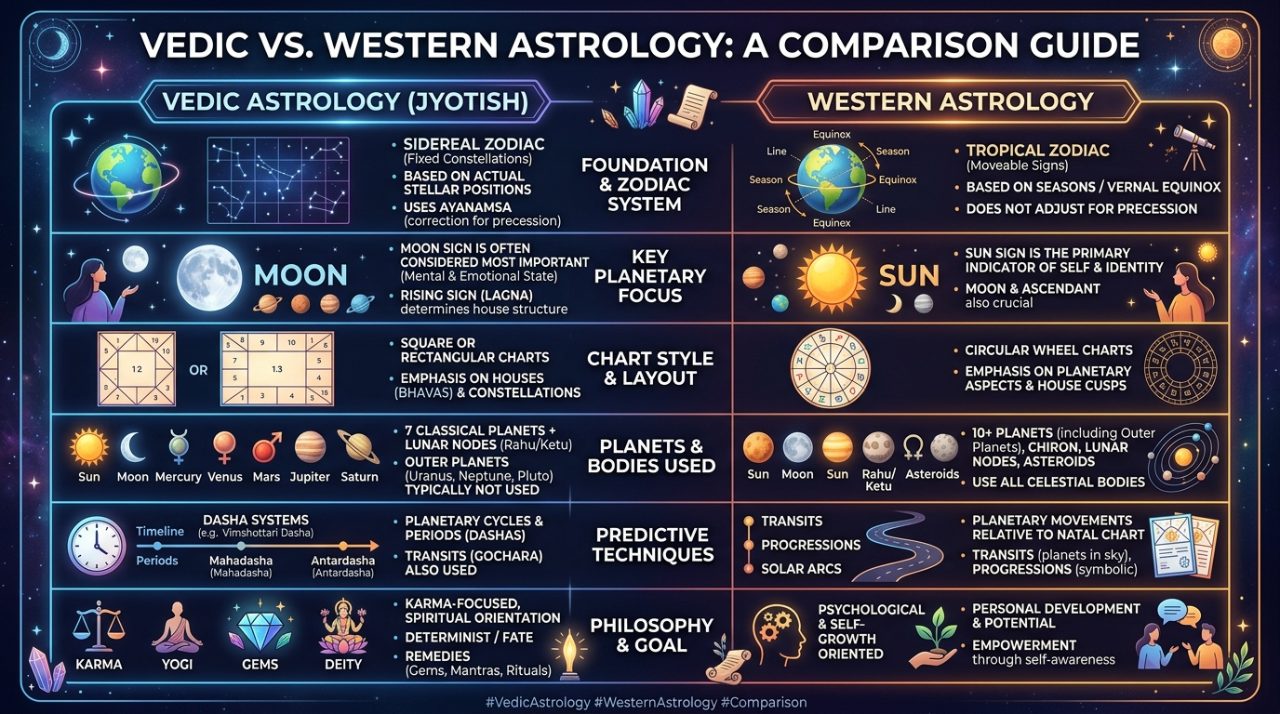
Vedic and Western astrology share ancient roots but diverge in one crucial way: the zodiac they use. Western astrology follows the Tropical zodiac, tied to the seasons and the equinoxes. Vedic astrology (Jyotish) follows the Sidereal zodiac, anchored to the actual positions of the constellations. Because of a slow shift called precession, the two are currently about 24 degrees apart — which is why your sign can differ between systems.
The emphasis differs too. Western astrology leans psychological — personality, motivation and self-understanding. Vedic astrology leans predictive, using planetary periods called dashas to time events around marriage, career and health, alongside remedies such as mantras and gemstones.
Neither is “more correct”; they answer different questions. If you want to understand your inner patterns, Western astrology is a wonderful mirror. If you want timing, life-event guidance and practical remedies rooted in classical tradition, Vedic astrology is built for exactly that. Many people, in the end, enjoy both.
Classical Foundations in Jyotish
A tradition with its own texts
Jyotish is one of the six Vedangas, the limbs of Vedic knowledge, and its name means "the science of light". Its core is preserved in classical texts that are still studied line by line today. Brihat Parashara Hora Shastra (BPHS) sets out houses, planetary dignities, divisional charts, yogas and the dasha systems. Phaladeepika by Mantreshwara summarises the results of planets and yogas. The Jaimini Upadesa Sutras offer a complementary system based on sign aspects and Chara Karakas, and Tajika Neelakanthi covers annual charts and horary questions. Western astrology also has a long history, from Hellenistic texts to modern psychological astrology, but its sources and emphasis are different.
The zodiac question in detail
The tropical zodiac used in Western astrology starts 0° Aries at the spring equinox, so the signs are tied to the seasons. The sidereal zodiac used in Jyotish is anchored to the fixed stars. Because the Earth's axis slowly wobbles (precession), the two zodiacs drift apart by roughly one degree every 72 years. The difference, called the ayanamsha, is now about 24 degrees. Most Vedic astrologers use the Lahiri (Chitrapaksha) ayanamsha, the official standard in India.
The practical result is that around two-thirds of people find their Sun sign moves back one sign in the Vedic chart, and the Moon and ascendant shift in the same way. A Western Taurus is often a Vedic Aries. Neither chart is wrong; they measure from different starting points.
What Jyotish uses that Western astrology usually does not
- The 27 Nakshatras: lunar mansions of 13°20′ each, which describe the mind in fine detail and set the starting point of the dasha.
- Divisional charts (Vargas): BPHS describes sixteen, including the D-9 Navamsha for marriage and inner strength and the D-10 Dasamsha for career.
- The dasha systems: above all the 120-year Vimshottari dasha, a timeline of planetary periods unique to each chart.
- Yogas: named planetary combinations, such as Raja yogas for status, Dhana yogas for wealth and Gaja Kesari yoga for wisdom and support.
- Rahu and Ketu: the lunar nodes, treated as full karmic indicators.
House, Planetary & Dasha Dynamics
Whole-sign houses and the ascendant
Most Vedic astrologers use whole-sign houses: the sign rising at birth becomes the entire 1st house, the next sign the 2nd, and so on. Western astrologers often use quadrant systems such as Placidus, where house sizes vary. This means a planet can sit in a different house in each system. Jyotish also reads the chart from the Moon (Chandra Lagna) as a second ascendant, which Western astrology rarely does.
Planets: the visible seven and the nodes
Classical Jyotish works with the Sun, Moon, Mars, Mercury, Jupiter, Venus and Saturn, plus Rahu and Ketu. Uranus, Neptune and Pluto are not part of the classical system, although some modern Vedic astrologers note them. Each planet has exaltation and debilitation signs, friendships and enmities, and Shadbala, a sixfold measure of strength, all of which shape the reading.
Aspects
Western astrology measures aspects by angle: trines, squares, oppositions and so on, with orbs. Parashari Jyotish uses sign-based aspects (Drishti). Every planet aspects the 7th sign from itself, while Mars also aspects the 4th and 8th, Jupiter the 5th and 9th, and Saturn the 3rd and 10th. Jaimini astrology adds its own Rashi Drishti, aspects between signs.
Timing: dashas and transits
This is where Vedic astrology is most distinctive. The Vimshottari dasha divides life into Mahadashas of different lengths: Ketu 7 years, Venus 20, Sun 6, Moon 10, Mars 7, Rahu 18, Jupiter 16, Saturn 19 and Mercury 17. Each is subdivided into Antardashas. Events are expected when the planets involved in a promise in the birth chart are running their periods, and when transits (Gochar), especially of Saturn and Jupiter, confirm them. Western astrology times events mainly with transits, progressions and solar returns.
The same question, two approaches
Suppose someone asks when they will change careers. A Western astrologer may look at transits to the Midheaven and progressed planets. A Vedic astrologer will examine the 10th house and its lord, the D-10 chart and the Amatyakaraka, then identify which upcoming Antardasha activates those factors and when Saturn and Jupiter support them. Both can be meaningful, but the Vedic method produces a more specific timeline.
Conscious Karma & Practical Vedic Remedies
The greatest practical difference is that Jyotish is joined to a full system of remedies (Upayas). A chart is read as a picture of past karma. Through Kriyamana karma, the choices made now, you can work with it rather than simply accept it.
- Mantra: repetition of the planet's mantra with attention, on its weekday.
- Dana: charity linked to the planet, such as feeding people on Saturdays for Saturn.
- Dhyana and breath: meditation and Swarodaya, awareness of the active nostril, to act at the right moment.
- Pancha Mahabhuta balance: working with the five elements to bring the body and mind into harmony.
- Gemstones: recommended only after a careful check of whether the planet is a functional benefic for your ascendant, and never as a substitute for conduct.
If you are curious about your personality, a Western chart is a fine mirror. If you want to know when things are likely to unfold and what you can do about it, a Vedic reading is designed for that question. Many of my clients in Surrey and abroad have read Western astrology for years and come to Jyotish for timing. It is worth looking at your sidereal chart and seeing which description fits.