The Ultimate Guide to Understanding Your Birth Chart (Natal Chart)
· By Jag Mallah, Vedic astrologer · Analysis of Karma
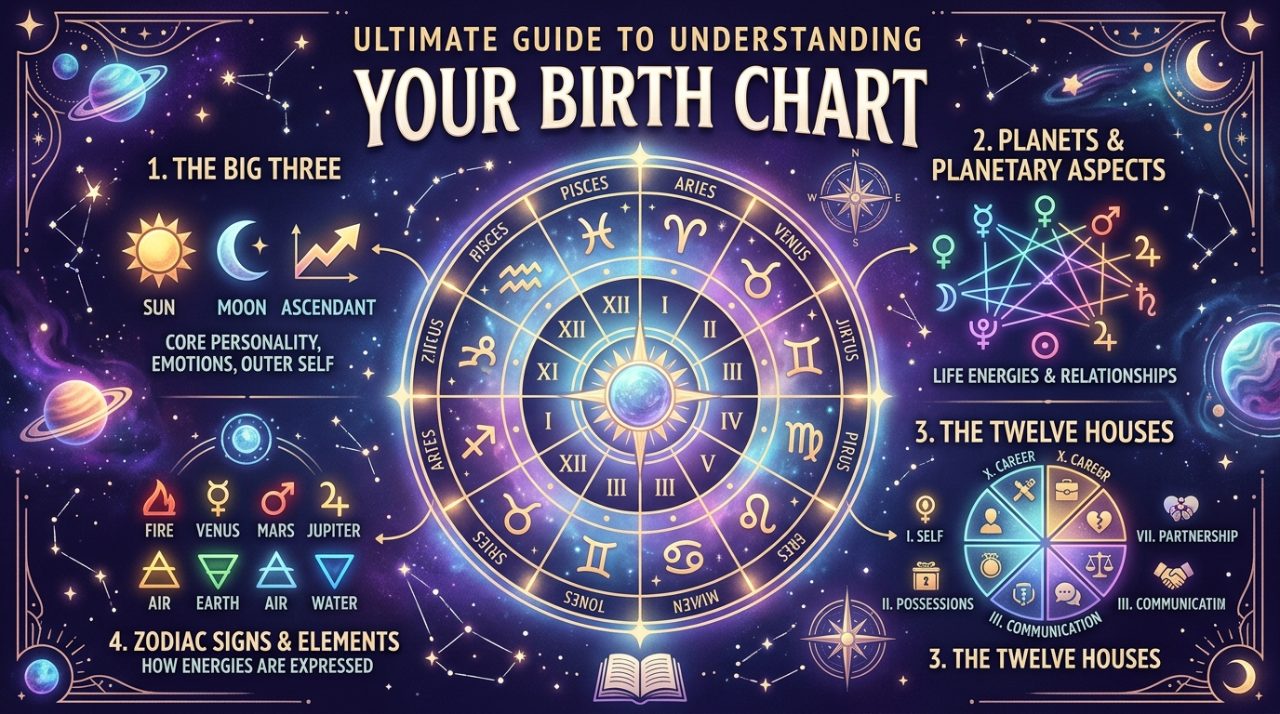
Your birth chart — also called the natal chart or Kundli — is a snapshot of the sky at the precise moment you were born. Every planet was sitting in a particular sign and house, and that exact arrangement never repeats. It is the single most important tool in astrology, and in classical Jyotish it is the foundation of every reading.
Three ingredients build the chart. The signs (Aries through Pisces) describe how energy expresses itself. The planets describe what kind of energy is at play — the Sun is identity, the Moon is emotion, Mercury is the mind, and so on. The houses, twelve slices of the chart, describe where in life that energy lands: money, marriage, career, health.
In the Vedic chart, each of the twelve houses governs an area of life — self, wealth, courage, home, creativity, health, partnership, transformation, fortune, career, gains and liberation. The nine planets move through these houses and through the twenty-seven nakshatras, colouring each area with their nature.
The Ascendant, or Rising sign, is your starting point — the sign on the eastern horizon at your birth. It frames the whole house system and is why two people born on the same day can feel so different. Once you know your Ascendant and the sign and house of each planet, the chart begins to read like a sentence.
Reading a Vedic birth chart is less about prediction and more about understanding pattern and timing. The dasha system tells us which planet is shaping your current chapter. Remedies — mantra, gemstone, meditation — help you work with that energy rather than against it.
Reading well takes practice, but you can start today: find your Sun, Moon and Rising, notice which houses hold the most planets, and look at where Saturn sits to understand your biggest lessons. Know your ascendant and the planet ruling your present dasha, and the chart slowly begins to speak. From there, a personal consultation can connect the dots into one clear, practical story.
Classical Foundations in Jyotish
The sidereal zodiac
Jyotish measures the zodiac against the fixed stars, not the seasons. Because of the slow precession of the equinoxes, the sidereal and tropical zodiacs now differ by about 24 degrees, a value called the ayanamsha. Most Indian astrologers use the Lahiri (Chitrapaksha) ayanamsha. In practice, most planets in your Vedic chart sit one sign earlier than in a Western chart, which is why many people discover a "new" Sun or Moon sign when they first see their Kundli.
The nine Grahas
Brihat Parashara Hora Shastra (BPHS), the foundational text of Parashari astrology, describes nine Grahas (planets or "graspers"):
- Sun (Surya): the soul, father, authority and vitality.
- Moon (Chandra): the mind, mother, emotions and nourishment.
- Mars (Mangal): courage, energy, siblings and property.
- Mercury (Budha): intellect, speech, trade and learning.
- Jupiter (Guru): wisdom, teachers, children, dharma and expansion.
- Venus (Shukra): love, marriage, comfort and the arts.
- Saturn (Shani): discipline, time, karma, service and endurance.
- Rahu: the north lunar node: desire, obsession, the foreign and the new.
- Ketu: the south lunar node: detachment, past mastery and spiritual insight.
The 27 Nakshatras
Beneath the twelve signs lie 27 lunar mansions, the Nakshatras, each of 13°20′ and divided into four Padas. Your Moon's Nakshatra (your Janma Nakshatra) is one of the most personal factors in the chart. It describes your emotional nature, gives the first syllable of a traditional name, and sets the starting point of your Vimshottari dasha. The Nakshatras are ruled in a repeating sequence: Ashwini by Ketu, Bharani by Venus, Krittika by the Sun, Rohini by the Moon, Mrigashira by Mars, Ardra by Rahu, Punarvasu by Jupiter, Pushya by Saturn and Ashlesha by Mercury, and so on around the zodiac.
The twelve Bhavas and their groups
Jyotish counts houses sign by sign from the ascendant (whole-sign houses), and groups them by function:
- Kendras (1, 4, 7, 10): the pillars of life: self, home, partnership and career. Planets here are strong and visible.
- Trikonas (1, 5, 9): the houses of fortune, merit and dharma. Their lords are the chart's natural supporters.
- Dusthanas (6, 8, 12): houses of struggle, transformation and loss, which also give resilience, research and liberation.
- Upachayas (3, 6, 10, 11): houses that improve with time and effort.
The four aims of life (Purusharthas) are spread across the chart: Dharma (1, 5, 9), Artha (2, 6, 10), Kama (3, 7, 11) and Moksha (4, 8, 12). A chart weighted toward one group shows where the soul's attention naturally goes.
Divisional charts (Vargas)
BPHS describes sixteen divisional charts, each a magnified view of one area of life. The D-9 Navamsha is the most important after the birth chart. It shows the true strength of each planet, the quality of marriage and the inner self that matures with age. A planet strong in both the D-1 and the D-9 (Vargottama, in the same sign in both) delivers its promise reliably. Others include the D-10 for career, D-7 for children, D-12 for parents and the D-60 for deeper karma.
House, Planetary & Dasha Dynamics
Dignity: how comfortable is each planet?
A planet's sign shows how freely it can express itself. Each planet has a sign of exaltation where it is strongest: Sun in Aries, Moon in Taurus, Mars in Capricorn, Mercury in Virgo, Jupiter in Cancer, Venus in Pisces and Saturn in Libra. It is debilitated in the opposite sign. Own signs and friendly signs also give strength. Phaladeepika notes that a debilitated planet can be redeemed through Neecha Bhanga, the cancellation of debilitation, for example when the lord of its sign is in a Kendra. So no placement should be judged in isolation.
Lordship: who does what in your chart?
Each planet rules one or two houses from your ascendant, and those lordships decide whether it acts as a friend or a challenger in your particular chart. The same Saturn that brings delays to one person can be the greatest benefactor of another, because it rules their 9th and 10th houses. This is why personal astrology must start from the ascendant, not from Sun signs.
Drishti: planetary aspects
All planets aspect the 7th house from themselves. Mars also aspects the 4th and 8th, Jupiter the 5th and 9th, and Saturn the 3rd and 10th, and many astrologers give Rahu and Ketu Jupiter-like 5th and 9th aspects. Jupiter's aspect protects and expands whatever it touches; Saturn's slows, tests and matures.
Yogas: the chart's signature combinations
Yogas are named combinations that describe distinctive results. Some well-known examples:
- Pancha Mahapurusha yogas: Mars, Mercury, Jupiter, Venus or Saturn in its own or exaltation sign in a Kendra (Ruchaka, Bhadra, Hamsa, Malavya and Shasha).
- Gajakesari yoga: Jupiter in a Kendra from the Moon, for wisdom, respect and resilience.
- Raja yogas: links between Kendra and Trikona lords, for status and achievement.
- Dhana yogas: links between the 2nd, 5th, 9th and 11th lords, for wealth.
A yoga only gives its full result when its planets are strong and their dashas run.
Vimshottari dasha: the timeline
Timing is the gift of Jyotish. The Vimshottari dasha divides a 120-year life into planetary periods: Ketu 7 years, Venus 20, the Sun 6, the Moon 10, Mars 7, Rahu 18, Jupiter 16, Saturn 19 and Mercury 17. The sequence starts from the lord of your Moon's Nakshatra. Each Mahadasha divides into Antardashas and finer Pratyantardashas. Whatever a planet promises in your chart, it delivers mainly in its own period.
Gochar: transits
Transits show the weather passing over your natal promise. Saturn spends about two and a half years in each sign, and its passage over the 12th, 1st and 2nd houses from your Moon is the famous Sade Sati, a seven-and-a-half-year period of maturing responsibility. Jupiter takes roughly a year per sign and often brings opportunity to the houses it transits and aspects. Transits are always read through the dasha. A good transit in a weak dasha gives little; a demanding transit in a strong dasha is usually manageable.
Two more lenses: Jaimini and Nadi
The Jaimini Upadesa Sutras add the Chara Karakas, significators set by planetary degree. The highest, the Atmakaraka, describes the soul's central lesson. Bhrigu Nandi Nadi reads planets connected by sign, especially in trines, as a single story, and watches Jupiter's transit over natal planets to time when that story unfolds.
A simple way to begin reading your chart
- Note your ascendant and the sign and house of its lord, the most personal planet in your chart.
- Find your Moon sign and Nakshatra, the key to your mind and your dasha.
- See which houses hold the most planets: that is where life's attention gathers.
- Check each planet's dignity and any Neecha Bhanga.
- Look up your current Mahadasha and Antardasha and what those planets rule.
- Note where Saturn and Jupiter are transiting from your Moon.
Conscious Karma & Practical Vedic Remedies
The birth chart reflects Prarabdha karma, the portion of past karma ripening in this life. It does not take away your freedom. Kriyamana karma, what you do now, is always yours, and Vedic remedies are tools for using that freedom wisely rather than ways of buying a different fate.
- Dhyana (meditation): steadies the Moon, the mind, so that every other remedy goes deeper.
- Mantra: the Beej mantra of a planet you need to strengthen, chanted daily with attention.
- Dana (charity): given on the planet's weekday to people who need it, for example food on Saturdays for Saturn.
- Conduct: honouring what each planet represents. Respect for teachers for Jupiter, honesty in speech for Mercury, disciplined work for Saturn.
- Pancha Mahabhuta balance: simple elemental practices, such as morning sunlight for a weak Sun, water and rest for an agitated Moon, and grounding routines for an airy, restless chart.
- Gemstones, carefully: only for functional benefics, after a proper chart check.
Reading your own chart is rewarding, and a personal consultation can bring the pieces together. That means confirming the exact ascendant, weighing the dasha you are in, and turning the analysis into clear, practical steps.