Sun, Moon, and Rising Signs: What They Mean & How to Find Yours
· By Jag Mallah, Vedic astrologer · Analysis of Karma
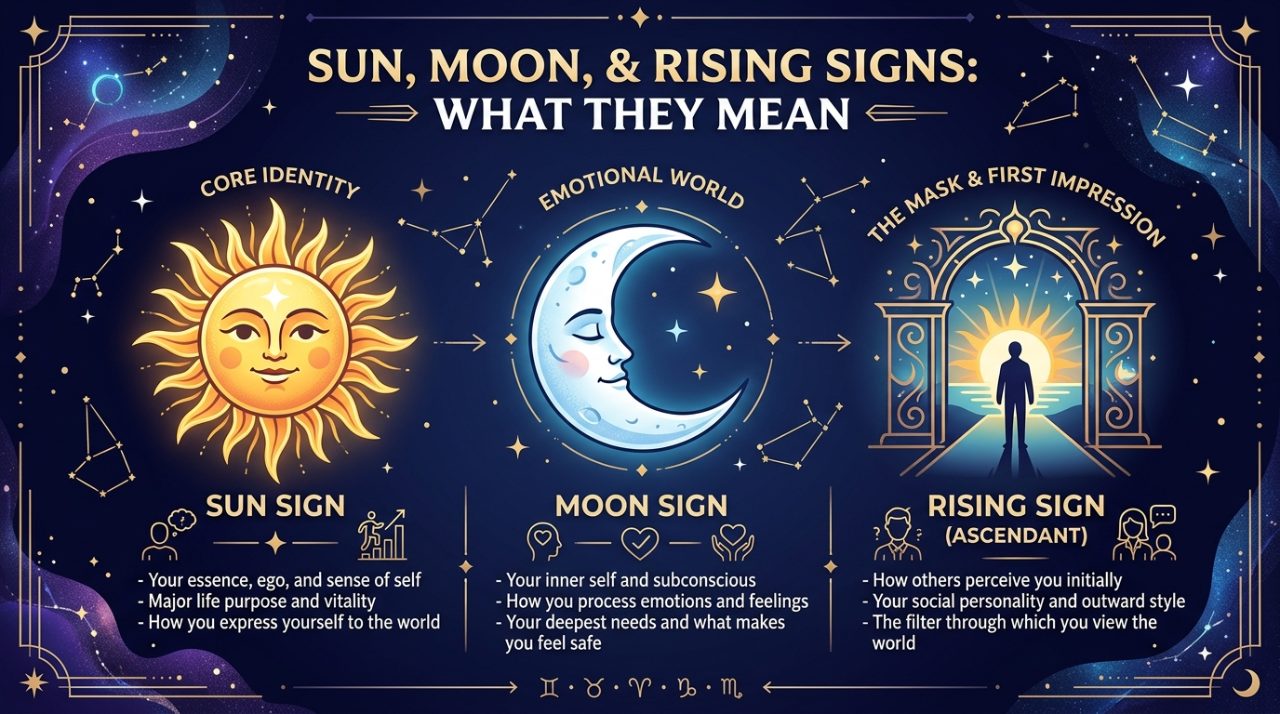
If astrology had a headline, it would be your big three: the Sun, the Moon and the Rising sign. Together they sketch the core of your personality before any deeper reading begins.
Your Sun sign is your essential identity — your ego, your vitality and the role you are here to grow into. It is set by your date of birth, which is why it is the sign most people know. Your Moon sign rules your emotional inner world: your instincts, your moods and what makes you feel safe. Because the Moon moves quickly, you need your date and rough time of birth to find it.
Your Rising sign, or Ascendant, is the face you meet the world with — your first impression and outward style. It changes roughly every two hours, so it needs your exact birth time. This is why two people with the same Sun sign can come across so differently.
To find all three you need three details: date, time and place of birth. Enter them into any chart calculator, or better, bring them to a reading — because the interplay between the three, not just the labels, is where the real insight lives.
Classical Foundations in Jyotish
Why Jyotish puts the ascendant and Moon first
Western astrology is famous for Sun signs, but classical Jyotish gives the Lagna (ascendant) and the Moon the leading roles. Brihat Parashara Hora Shastra builds the whole house system from the Lagna, which represents the body, the self and the overall direction of life. The Moon represents the mind (Manas), and the chart drawn from the Moon sign, the Chandra Lagna, is the second reference point for every judgement. The Sun is the Atma, the soul and vitality, deeply important but read as one of three pillars rather than the whole story.
The sidereal shift
Jyotish uses the sidereal zodiac, measured against the fixed stars. Today it differs from the tropical zodiac by about 24 degrees, the ayanamsha. So someone who has always known themselves as a Western Leo will often find their Vedic Sun in Cancer, and the same shift affects the Moon and ascendant. Neither is wrong; they are two measuring systems. But for Vedic interpretation, dashas and Nakshatras, the sidereal positions must be used.
The Nakshatra: the hidden fourth factor
Within each sign lie the 27 Nakshatras, lunar mansions of 13°20′ each. Your Janma Nakshatra, the Nakshatra of your Moon, is one of the most personal details in Jyotish. It describes emotional nature and instincts, gives the traditional first syllable of a name, and determines the starting point of the Vimshottari dasha, the timeline of your life. Two people with the same Moon sign but different Nakshatras can feel very different. A Moon in Ashwini (ruled by Ketu) is quick and pioneering; a Moon in Rohini (ruled by the Moon itself) is sensual and steady.
What each represents
- Lagna: the body, temperament, health and the way life unfolds; your "instrument" in this life.
- Moon (Rashi): the mind, emotions, mother, comfort and how you experience events.
- Sun: the soul, father, authority, confidence and life purpose.
House, Planetary & Dasha Dynamics
The lords matter as much as the signs
Knowing your ascendant sign is a start; knowing where its lord sits is where real reading begins. A Libra ascendant with Venus in the 10th house describes someone whose identity is closely tied to career and public life. The same ascendant with Venus in the 12th suggests a more private, spiritual or foreign-oriented path. The same principle applies to the Moon's sign lord, the dispositor of the mind.
Strength and dignity
The Moon is exalted in Taurus and debilitated in Scorpio; the Sun is exalted in Aries and debilitated in Libra. The Moon's Paksha Bala (waxing or waning) also matters: a bright, waxing Moon near full is considered strong and supportive, a dark Moon near Amavasya weaker. A strong Lagna lord and a strong Moon together give resilience, which is one of the first things an astrologer checks.
The three Lagnas together
Classical practice often reads a chart from the ascendant, the Moon and the Sun in turn. When a house is strong from all three, its results are emphasised; when a difficulty appears from only one, it is moderated. This Sudarshana Chakra principle, described in BPHS, is a useful way to weigh the big three together rather than separately.
Timing through the Moon
Because the Vimshottari dasha starts from the Moon's Nakshatra, the Moon quietly governs the timing of your whole life. Transits are also read primarily from the Moon sign. Saturn's Sade Sati, for example, is counted from the natal Moon, not the Sun. This is why Vedic horoscopes are written for Moon signs.
Finding your big three
- Collect your date, exact time and place of birth.
- Cast a sidereal chart with the Lahiri ayanamsha.
- Note the ascendant sign and the house and sign of its lord.
- Note the Moon sign, Nakshatra and Pada, and therefore your starting dasha.
- Note the Sun's sign and house: the area of life where your purpose shines.
Insights from Jaimini and Nadi
The Jaimini Upadesa Sutras add the Atmakaraka, the planet with the highest degree, as a second "soul planet". It sometimes tells more about your deepest motivation than the Sun itself. Bhrigu Nandi Nadi reads the Sun as the father and authority and the Moon as the mother and mind, following how planets in trine to them shape those relationships.
Conscious Karma & Practical Vedic Remedies
The big three describe your instrument, mind and soul. Remedies keep all three in good tune.
- For the Lagna (body and vitality): a steady daily routine, physical care, and mantras or charity for the ascendant lord.
- For the Moon (mind): meditation, Pranayama, adequate sleep, time near water, respect for one's mother and mother figures, and Monday charity, such as milk or rice for those in need. A calm Moon makes every other remedy more effective.
- For the Sun (soul and confidence): morning sunlight, the Gayatri mantra or Surya Namaskar, honesty and responsible leadership, and respect for one's father.
- Pancha Mahabhuta balance: the elements of your three signs (fire, earth, air or water) show where you are naturally strong and where balance is needed. A chart with all three in fire benefits from calming, watery practices; one in water benefits from movement and sunlight.
- Conscious karma: knowing your temperament lets you choose responses rather than react, which is the essence of Kriyamana karma.
Your big three are only the beginning, but they are a powerful beginning. A full reading connects them to the houses, the yogas and the dasha you are running now.