Solar Return Charts: Predicting Your Birthday Year Ahead
· By Jag Mallah, Vedic astrologer · Analysis of Karma
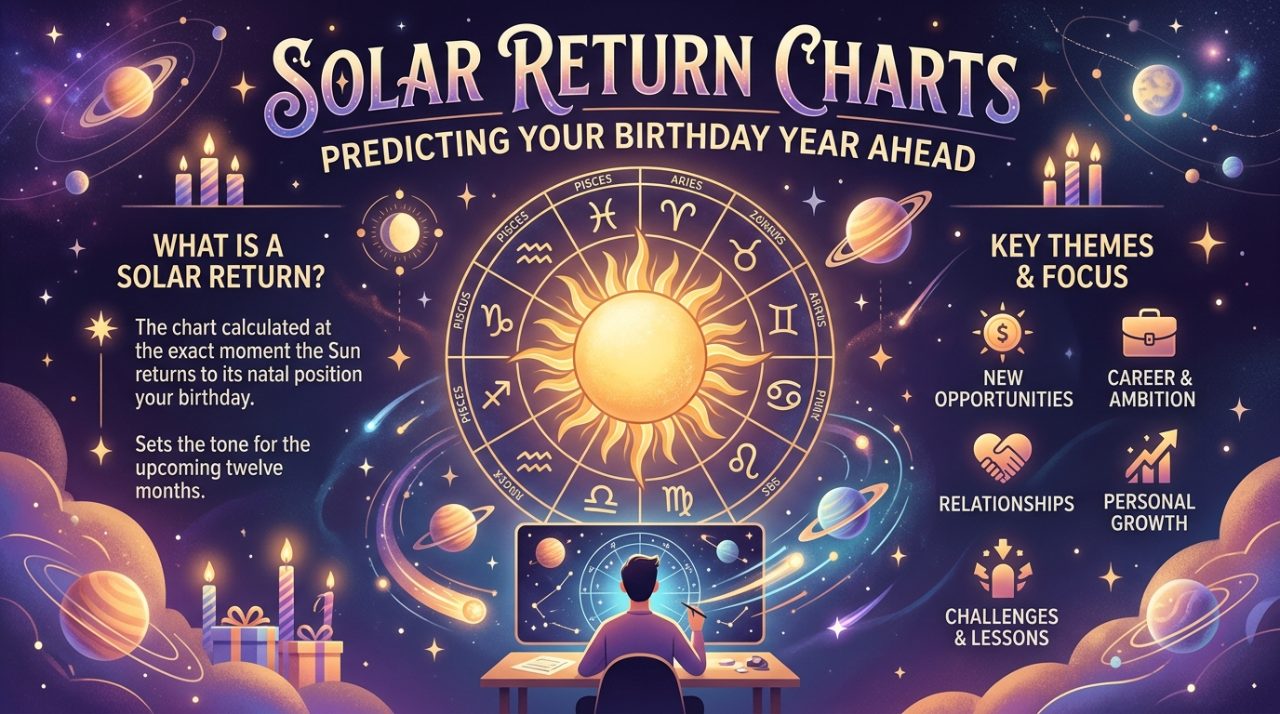
Every year, around your birthday, the Sun returns to the exact position it held when you were born. That precise moment creates a brand-new chart called the solar return — a forecast map for the twelve months ahead.
The solar return is read alongside your natal chart. The rising sign of the return, the house the Sun falls into, and the placement of the other planets all hint at the themes of your coming year. A solar return Sun in the career house may signal a year of professional focus; in the relationship house, a year where partnership takes centre stage. Aspects within the return chart show where ease and challenge are likely to appear.
What makes the solar return so useful is its timing. Rather than vague yearly horoscopes, it offers a chart tailored to you and valid only until your next birthday. Read with the longer planetary periods and current transits, it becomes a practical planning tool — a way to enter your new year knowing where to invest your energy and what to prepare for.
Classical Foundations in Jyotish
From solar return to Varshaphala
The idea of a birthday chart is shared by Western and Vedic astrology, but Jyotish has its own complete system for it: Tajika, whose best-known classical text is Tajika Neelakanthi, written by Neelakantha in the 16th century. Tajika divides into Samjna Tantra (its principles), Varsha Tantra (annual charts) and Prashna Tantra (horary questions). The annual chart it produces is called the Varsha Pravesha, the "entry of the year", and its interpretation is Varshaphala, the fruits of the year.
Two technical points set Varshaphala apart from a Western solar return:
- The sidereal zodiac: the return is calculated to the Sun's exact sidereal longitude at birth. The moment differs slightly from the tropical return, so the annual ascendant can differ too.
- Location: the chart is cast for where you are when the year begins, so a birthday spent in Surrey and one spent in Delhi produce different annual ascendants, a point worth knowing if you travel around your birthday.
The building blocks of the annual chart
- Varsha Lagna: the ascendant of the year, which sets its overall tone and focus.
- Muntha: a sensitive point that starts at your natal ascendant and moves forward one sign each year. Its house in the annual chart, and the condition of its lord, highlight a central theme. Muntha in the 9th, 10th or 11th house is traditionally considered favourable; in the 4th, 6th, 7th, 8th or 12th, it calls for care in that area.
- The Panchadhikaris: five office-bearers. They are the lord of the natal ascendant, the lord of the annual ascendant, the Muntha lord, the lord of the day or night Trirashi, and the lord of the sign holding the Sun (by day) or Moon (by night).
- Varsheshwara (lord of the year): chosen from the Panchadhikaris by strength and aspect to the annual ascendant. A strong year lord is like a capable minister running the year well.
- Sahams: sensitive points calculated from planetary longitudes, such as Punya (fortune), Vidya (education), Vivaha (marriage), Karma (work) and Putra (children), used for specific questions.
House, Planetary & Dasha Dynamics
Tajika aspects and yogas
Tajika uses its own aspects, measured by degree with orbs (Deeptamsha), and a set of sixteen Tajika yogas describing how planets interact. Among the most important:
- Ithasala: a faster planet applying to a slower one. The matter signified is moving toward fulfilment.
- Ishrafa (Easarpha): a faster planet separating from a slower one. The opportunity has passed or is fading.
- Nakta and Yamaya: a third planet transfers light between two others, so success comes through an intermediary.
- Kamboola: the Moon joins a fruitful Ithasala, strengthening the promised result.
- Manau and Radda: obstruction or weakening by a malefic or a retrograde planet.
These yogas, applied between the lord of the annual ascendant and the lord of the house in question, are the heart of Tajika prediction.
Mudda dasha: a year in chapters
Mudda dasha compresses the Vimshottari sequence into a single year. It divides the twelve months into planetary periods proportional to the full 120-year cycle, starting from a point calculated from the natal Moon's Nakshatra and the years elapsed. This gives a month-by-month map, for example a Jupiter Mudda period for growth, followed by a Saturn period for consolidation.
Natal promise first
No annual chart can give what the birth chart does not promise. Classical practice reads Varshaphala as a sub-layer of the natal chart and the running Vimshottari dasha. If your natal dasha supports marriage and the annual chart's 7th house and Vivaha Saham are strong, the year is likely. If the natal chart and dasha are silent, a favourable annual chart alone rarely delivers the event.
The houses of the year
Each house of the annual chart speaks for that area over the twelve months: the 10th and 11th for career and gains, the 7th for partnerships, the 4th for home and property, the 9th and 12th for travel and relocation, the 6th and 8th for health awareness and obstacles. Benefics in the Kendras of the annual chart and a strong year lord generally indicate a constructive year.
An illustration (hypothetical)
Imagine a person running a Jupiter Mahadasha with Mercury Antardasha, where Mercury rules their natal 10th house. In this year's annual chart, Muntha falls in the 10th house and Jupiter, strong in a Kendra, is chosen as the year lord. The lord of the annual ascendant forms an applying Ithasala with the 10th lord, and the Karma Saham is well placed. Each layer points the same way: the natal dasha activates career, the annual chart highlights it, and the Tajika yoga shows the matter coming together. An astrologer would read this as a strong year for a promotion or a new role, then use the Mudda dasha to narrow down the most likely months. It is the agreement between layers, not any single factor, that gives confidence.
Varshaphala and ordinary transits
Transits (Gochar) describe the planets moving through your natal chart day by day, and they continue to matter during the year. Varshaphala adds a fixed annual snapshot with its own ascendant, year lord and yogas, which gives a stable framework for the whole twelve months. In practice the two are read together: transits show the timing of events within the year, while the annual chart shows what the year is fundamentally about.
Varshaphala and Prashna together
Tajika also includes Prashna, horary astrology. Where Varshaphala answers "What will this year bring?", Prashna answers one sincere question asked at a particular moment, using a chart cast for that moment and the same Tajika aspects. The two are often combined. A Varshaphala sets the year's map, and a Prashna resolves a specific decision within it, even for people who do not know their exact birth time.
When to read your annual chart
The ideal time is a few weeks before your birthday, when the new Varsha Pravesha is about to begin, so you enter the year prepared. Because the chart depends on location, tell your astrologer where you expect to be on the birthday itself. A trip at that time can change the annual ascendant, and with it the houses of the whole year. Reviewing it again at the halfway point, or when a new Mudda period starts, keeps the forecast practical.
Conscious Karma & Practical Vedic Remedies
An annual forecast is most valuable when it shapes how you act. Within the framework of Kriyamana karma, the forecast becomes a plan.
- Plan with the Mudda periods: schedule launches, applications and important conversations in supportive periods, and use demanding ones for preparation and rest.
- Strengthen the year lord: recite its mantra on its weekday and practise the virtues it represents, for example generosity for Jupiter or discipline for Saturn.
- Support the Muntha house: if Muntha falls in a challenging house, give extra attention, patience and care to that area of life throughout the year.
- Begin the year consciously: traditionally the birthday itself is a day for gratitude, charity (Dana) and prayer. A short meditation on the morning of your birthday sets the intention for the year.
- Breath and timing: use Swarodaya awareness and favourable days (Tara Bala) for the year's key decisions.
- Pancha Mahabhuta balance: if the annual chart is fiery and hasty, emphasise calm, water and rest. If it is heavy and slow, emphasise movement, sunlight and fresh air.
A solar return in the Western sense tells you the theme of your year. A Vedic Varshaphala, read with your natal chart, dasha and Tajika yogas, tells you how that theme unfolds month by month, and what you can do to meet it well.