Saturn Return: What It Is, When It Happens, and How to Navigate It
· By Jag Mallah, Vedic astrologer · Analysis of Karma
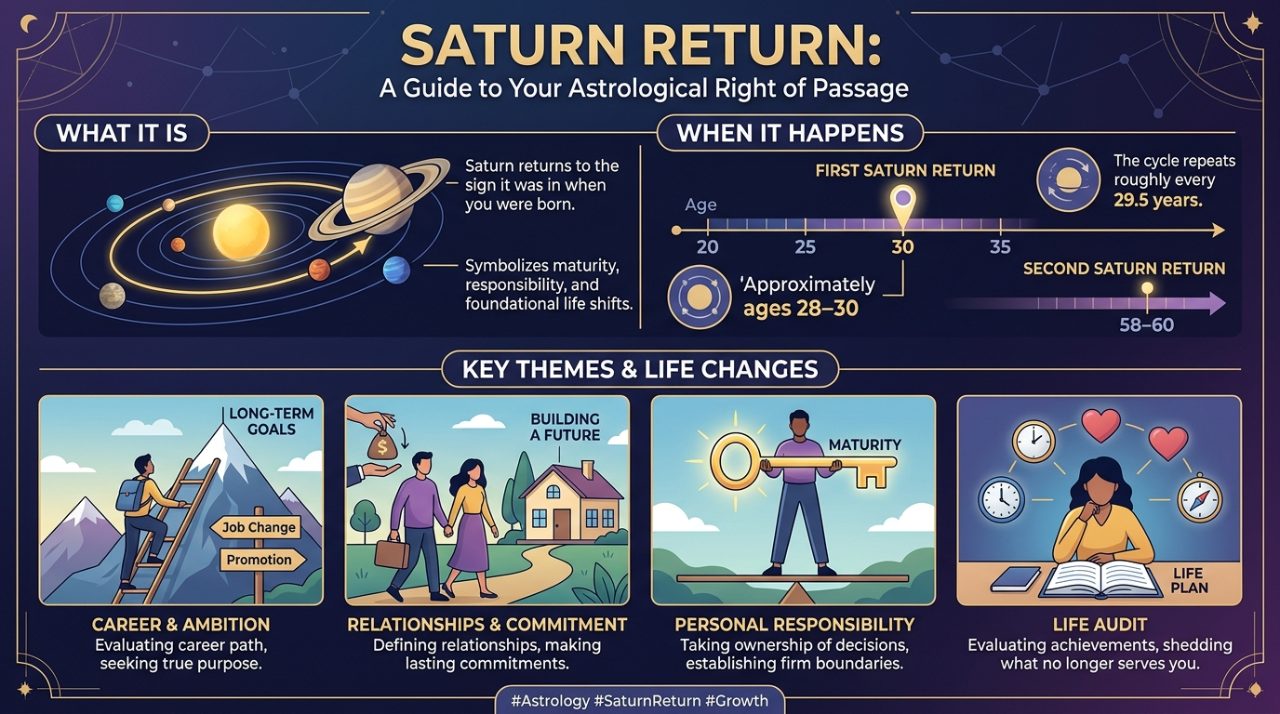
Roughly every 29 and a half years, Saturn completes a full orbit and returns to the exact place it occupied at your birth. This is the Saturn return, and it tends to arrive around ages 28–30, again near 58–60, and for some a third time in old age. The first is usually the most memorable.
Saturn is the planet of structure, responsibility and maturity, so its return often coincides with major thresholds: career pivots, marriages, moves, or the ending of things that no longer fit. It can feel heavy, as if life is testing whether your foundations are real. That pressure is the point — Saturn removes what is hollow so what remains can hold weight.
To navigate it, stop resisting change and start building deliberately. Commit to the work, the relationship or the path that genuinely matters, and release what you have outgrown. Handled with honesty, the Saturn return is less a crisis than a graduation — into a more grounded, authentic adult life.
Classical Foundations in Jyotish
Shani in the classical texts
Saturn, Shani, is the slowest of the classical planets, taking about 29.5 years to circle the zodiac and spending roughly two and a half years in each sign. Brihat Parashara Hora Shastra calls Saturn the significator of longevity, service, labour, discipline, detachment and sorrow, and describes him as a servant in the planetary cabinet. Phaladeepika links him with patience, endurance, old age, the common people and hard-won achievement. Saturn is also the planet of karma made visible: he gives results in proportion to effort and integrity, often after a delay.
What a Saturn return means in Jyotish
In Western astrology the Saturn return is a well-known milestone. Jyotish describes the same event in its own terms: transiting Saturn returning to the sign it occupied at birth. Because Jyotish uses the sidereal zodiac and whole-sign houses, the sign in question may differ from your Western one, and the Vedic return is read from that sign and the house it occupies from your ascendant and Moon.
Saturn's dignity
How the return feels depends heavily on Saturn's condition in your chart. Saturn is exalted in Libra, debilitated in Aries, and owns Capricorn and Aquarius, with Aquarius his Moolatrikona sign. For Taurus and Libra ascendants Saturn is a Yogakaraka, ruling both a Kendra and a Trikona, and his return can mark one of the most productive periods of life. For other ascendants, his houses decide what is restructured.
House, Planetary & Dasha Dynamics
The house of your natal Saturn
The return reactivates the house where Saturn sits in your birth chart:
- 1st house: identity, health and the direction of life are reviewed.
- 4th house: home, property, mother and inner peace.
- 7th house: marriage and partnerships, often commitment or restructuring.
- 10th house: career and responsibility, frequently a promotion that comes with a heavier load.
- 11th house: income, networks and long-term goals.
- 6th, 8th and 12th houses: health routines, debts, hidden matters, expenses and spiritual life, areas where Saturn tends to reward consistent effort.
Sade Sati and Ashtama Shani
Jyotish emphasises two further Saturn transits counted from the natal Moon:
- Sade Sati: the roughly 7.5 years when Saturn moves through the sign before the Moon, the Moon's sign and the sign after it. It is traditionally a period of pressure on the mind and of major restructuring.
- Ashtama Shani: Saturn transiting the 8th sign from the Moon, associated with obstacles and change.
- Kantaka Shani: Saturn in the 4th, 7th or 10th from the Moon, in some traditions considered testing for home, relationships or work.
When a Saturn return falls during Sade Sati, people often describe it as one of the defining periods of their lives. When it falls outside these phases, it may pass far more gently.
The dasha decides the volume
A transit only gives strong results when the dasha supports it. If you are running Saturn Mahadasha or Antardasha, or the dasha of the lord of the sign Saturn occupies, the return becomes central. If your dasha belongs to a strong benefic, the return may feel like healthy consolidation rather than strain. This is why two people of the same age can experience their Saturn returns so differently.
Ashtakavarga
The Ashtakavarga system in BPHS gives each sign a score for each planet. When Saturn transits a sign with high bindus (points) in his own Ashtakavarga, his transit tends to be constructive. Low scores suggest more effort is needed. It is one of the most reliable classical tools for judging a Saturn transit.
The Nadi view
Bhrigu Nandi Nadi treats Saturn as the native's karma and profession. In this tradition, Saturn's transit over its own natal position and the signs in trine to it frequently coincides with job changes, new responsibilities or a change of direction, which matches what many people report around age 29.
Timing your own return
- Find your sidereal natal Saturn sign.
- Note the house it occupies from your ascendant and from your Moon.
- Check whether the transit overlaps with Sade Sati.
- Identify the Mahadasha and Antardasha you will be running.
- Look at Saturn's Ashtakavarga score for that sign.
Conscious Karma & Practical Vedic Remedies
Saturn is not malicious; he is a teacher of responsibility. The most powerful remedies are therefore changes in conduct, which is the very definition of Kriyamana karma.
- Discipline and duty: keep routines, finish what you start and take responsibility without complaint. Saturn rewards consistency more than any ritual.
- Service (Seva): help the elderly, labourers, people with disabilities and anyone who is struggling.
- Dana: on Saturdays, offer black sesame, mustard oil, blankets or food to those in need.
- Mantra: *Om Sham Shanaishcharaya Namah*, or the Shani Stotra, recited calmly on Saturdays. Many people also recite the Hanuman Chalisa.
- Dhyana: a short daily meditation on the breath. Saturn governs the Vata (air) quality, and steadiness of breath steadies the mind.
- Pancha Mahabhuta balance: grounding practices such as walking, regular meals and early sleep balance Saturn's dry, airy nature.
- Gemstones: blue sapphire is never worn casually. It is considered only when Saturn is a functional benefic for your ascendant, and after careful evaluation.
The Saturn return asks a simple question: what in your life is real and worth building on? Answer it honestly and Saturn usually gives back far more than he takes.