What Are the North and South Nodes? Unlocking Your Karmic Path
· By Jag Mallah, Vedic astrologer · Analysis of Karma
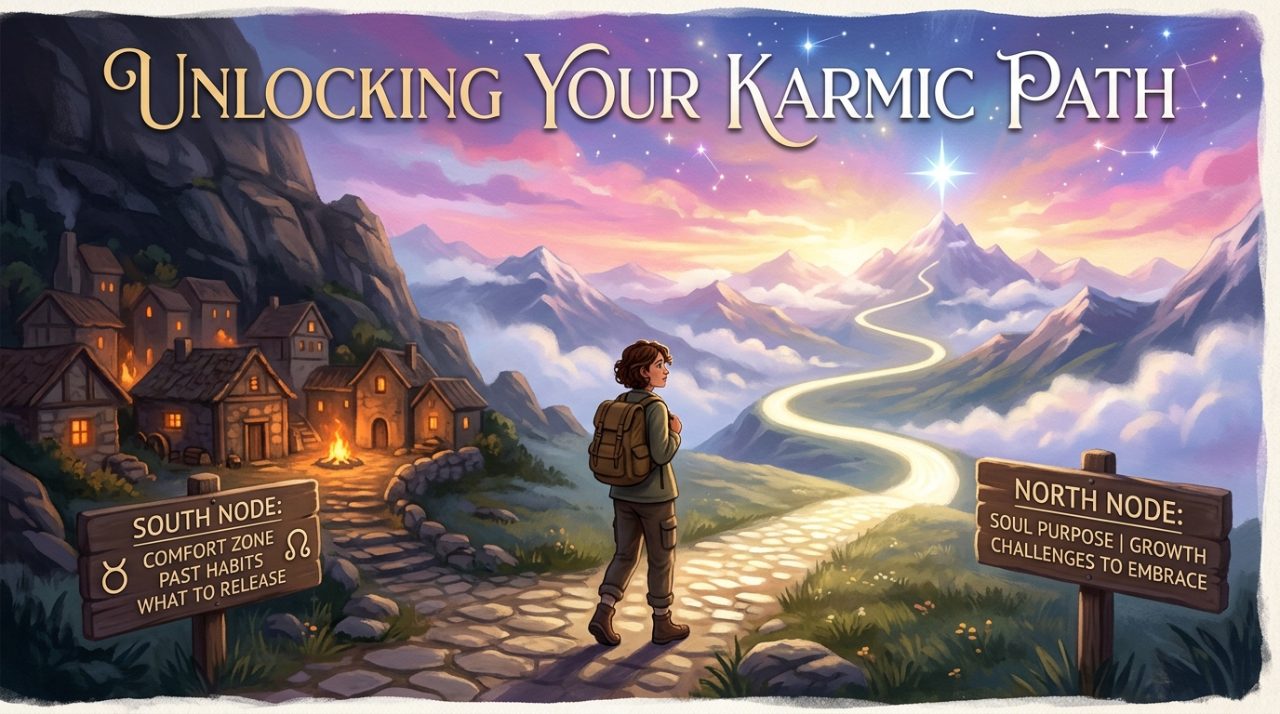
The North and South Nodes — known in Vedic astrology as Rahu and Ketu — are not planets but two points where the Moon’s path crosses the Sun’s. Despite being invisible, they carry some of the deepest meaning in a chart, describing your karmic axis: where you have been, and where you are growing toward.
The South Node (Ketu) represents the past — talents, habits and comfort zones carried from earlier experience. It comes easily, sometimes too easily, and can become a place you hide. The North Node (Rahu) points to the future — unfamiliar, uncomfortable, and exactly where your growth lies. Following it feels like a stretch precisely because it is new soul territory.
The nodes always sit opposite each other, forming an axis across two signs and houses. Understanding that axis is like reading a compass for this lifetime: lean away from over-relying on the South Node’s old comforts, and consciously move toward the North Node’s lessons. That gentle, deliberate stretch is the heart of walking your karmic path.
Classical Foundations in Jyotish
The Chhaya Grahas
Rahu and Ketu are called Chhaya Grahas, shadow planets. They have no physical body; they are the two points where the Moon's orbit crosses the ecliptic, the Sun's apparent path. Eclipses happen only when a full or new moon falls near them, which is why tradition links them with the swallowing of the Sun and Moon.
The Puranic story of the Samudra Manthan, the churning of the ocean, tells how the demon Svarbhanu drank the nectar of immortality and was cut in two by Vishnu's discus. The head became Rahu, endlessly hungry; the body became Ketu, headless and detached. The image is still the best summary of their natures.
Their significations in the classical texts
Brihat Parashara Hora Shastra includes Rahu and Ketu among the nine grahas and gives them their own Mahadashas. Classical writers broadly agree:
- Rahu: ambition, obsession, foreign lands and people, technology, innovation, unconventional paths, illusion and sudden rise. Rahu behaves like Saturn in many respects.
- Ketu: detachment, spirituality, intuition, research, precision, past-life skill, liberation (Moksha) and sudden separation. Ketu behaves like Mars in many respects.
Many traditions consider Rahu strong in Taurus and Gemini and Ketu strong in Scorpio and Sagittarius, although texts differ on their exact exaltation signs.
The karmic axis
Because the nodes are always exactly opposite, they create an axis through two houses. Ketu's house shows where you arrive already knowing, sometimes so well that it feels empty. Rahu's house shows what you hunger for and must learn in this life. Bhrigu Nandi Nadi treats Ketu as a strong indicator of past-life karma and the direction the soul is moving away from, and Rahu as the direction it is moving toward.
House, Planetary & Dasha Dynamics
The six axes
- 1st–7th: self versus partnership. Rahu in the 1st seeks identity and recognition; Rahu in the 7th seeks relationship and partnership, often unconventional.
- 2nd–8th: security, family and wealth versus transformation, research and shared resources.
- 3rd–9th: courage, skills and initiative versus belief, teachers and higher learning.
- 4th–10th: home and inner peace versus career and public life.
- 5th–11th: creativity, children and personal intelligence versus networks, gains and collective goals.
- 6th–12th: service, health and daily discipline versus retreat, foreign lands and spiritual release.
The nodes are traditionally considered helpful in the Upachaya houses (3rd, 6th, 10th and 11th), where their restlessness is channelled into effort.
Nodes give the results of their lords
A key classical principle is that Rahu and Ketu, lacking bodies, give the results of the lord of the sign they occupy and of the planets they join or are aspected by. Rahu in Sagittarius, for example, carries much of Jupiter's condition. A node with a strong benefic lord can be very productive; a node in a difficult house with an afflicted lord asks for more care.
Conjunctions
- Rahu with the Sun or Moon: a classical eclipse combination, often linked with intensity in the matters of the father or mother, or of confidence and the mind.
- Rahu with Jupiter (Guru Chandala yoga): unconventional beliefs or teachers.
- Ketu with Jupiter: spiritual insight; often considered a good combination for inner life.
- Ketu with Mars: sharp, precise energy that needs a constructive outlet.
Rahu and Ketu dashas
The Rahu Mahadasha lasts 18 years and often brings major ambition, travel, migration or rapid change. Many people in the diaspora find that Rahu's period coincides with moving abroad. The Ketu Mahadasha lasts 7 years and tends to bring detachment, endings, spiritual interest and the need to simplify. The node transit through the zodiac takes about 18 years, spending about 18 months in each sign, and Rahu–Ketu returns occur around ages 18–19, 37 and 56.
The Jaimini view
The Jaimini Upadesa Sutras use Ketu in the 12th house from the Karakamsha (the Atmakaraka's Navamsha sign) as a classic indication of spiritual liberation. Jaimini also reads the nodes' sign aspects, adding another layer to their influence.
Conscious Karma & Practical Vedic Remedies
The nodes are among the clearest illustrations of Kriyamana karma: you cannot remove Rahu's hunger or Ketu's detachment, but you can direct them.
- For Rahu: clear goals, ethical ambition and honesty about what you really want. Rahu becomes constructive when its desire serves a purpose larger than the self.
- For Ketu: meditation, research, solitude and service without expectation of reward. Ketu becomes peaceful when detachment is chosen rather than forced.
- Mantra: *Om Rahave Namah* on Saturdays, *Om Ketave Namah* on Tuesdays, and the Durga mantra for Rahu or Ganesha mantra for Ketu, as many traditions advise.
- Dana: blankets, black sesame or support for people far from home for Rahu; help for animals, especially dogs, and for spiritual causes for Ketu.
- Dhyana and Swarodaya: the nodes are linked with the mind's extremes, so steady breath and observation are especially valuable.
- Pancha Mahabhuta balance: Rahu's airy restlessness calls for grounding routines; Ketu's fiery intensity calls for calm and cooling practices.
- Gemstones: hessonite or cat's eye are recommended only after careful evaluation, because they amplify very strong energies.
Reading the nodes well turns a vague sense of "something unfinished" into a clear direction: lean on Ketu's gifts, and walk deliberately toward Rahu's lessons.