The 12 Astrological Houses Explained: Where Life Happens
· By Jag Mallah, Vedic astrologer · Analysis of Karma
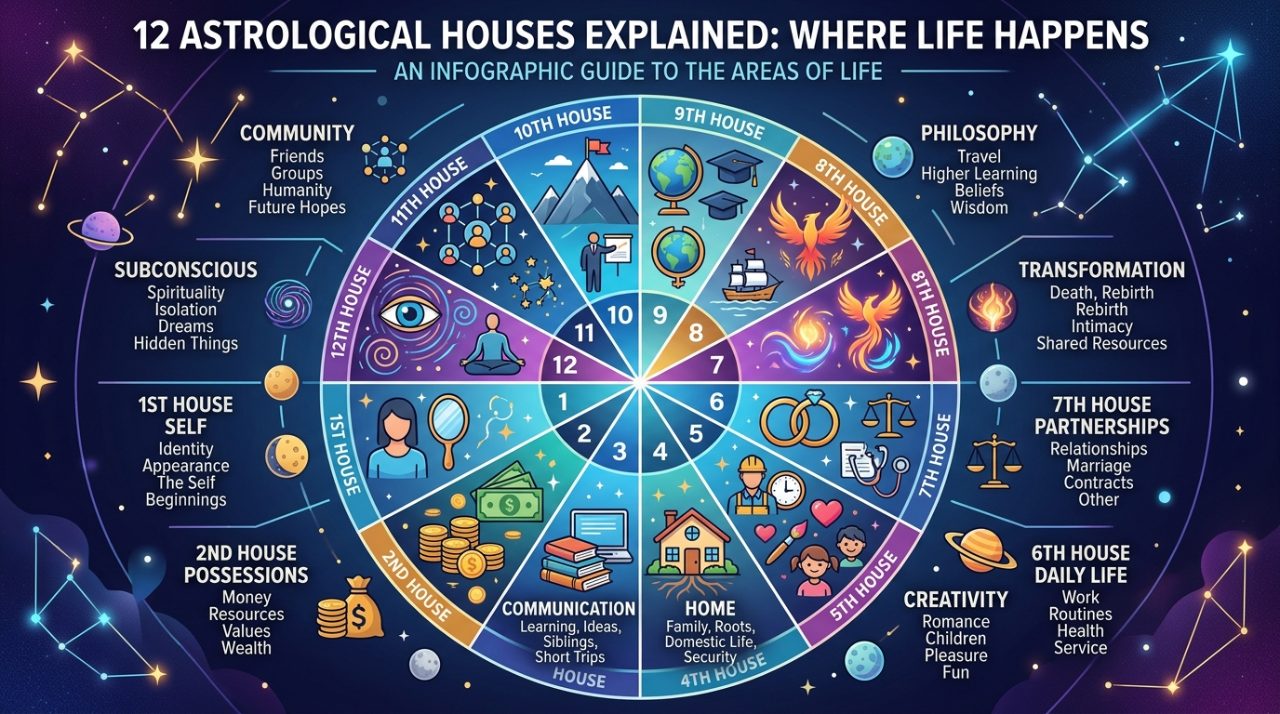
If planets are the actors and signs are their costumes, the twelve houses are the stages on which the drama plays out. Each house governs a specific arena of life, and the planets falling within it colour that arena.
The first six houses are personal. The 1st is the self, body and appearance; the 2nd, money and values; the 3rd, communication and siblings; the 4th, home and roots; the 5th, creativity, romance and children; the 6th, daily work, routine and health. The upper six reach outward. The 7th rules partnership and marriage; the 8th, transformation, shared resources and the hidden; the 9th, higher learning, travel and philosophy; the 10th, career and public standing; the 11th, friendships, networks and gains; the 12th, solitude, spirituality and release.
When you read a chart, notice which houses are crowded with planets — those are the life areas where the most energy and story concentrate. An empty house is not a problem; it simply means that theme runs quietly in the background of your life.
Classical Foundations in Jyotish
Bhavas in Brihat Parashara Hora Shastra
Jyotish calls the houses Bhavas, literally "states of being". Brihat Parashara Hora Shastra devotes a full chapter to the significations of each house and further chapters to the results of each house lord in each house. Most Vedic astrologers use whole-sign houses: the entire rising sign is the 1st house, the following sign the 2nd, and so on. This keeps the chart clear and is the system assumed by the classical texts.
The Vedic names and meanings of the houses
- 1st, Tanu Bhava: the body, temperament, health and the direction of life.
- 2nd, Dhana Bhava: wealth, family, speech, food and early education.
- 3rd, Sahaja Bhava: courage, siblings, effort, communication and short journeys.
- 4th, Sukha Bhava: mother, home, property, vehicles, education and inner happiness.
- 5th, Putra Bhava: children, intelligence, creativity, mantra and Purva Punya, the merit carried from past lives.
- 6th, Ripu Bhava: illness, debts, enemies, competition, service and daily work.
- 7th, Kalatra Bhava: marriage, partnership, business and public dealings.
- 8th, Ayur Bhava: longevity, sudden changes, inheritance, research and the occult.
- 9th, Dharma Bhava: fortune, father, teachers, higher learning, long journeys and dharma.
- 10th, Karma Bhava: profession, status, authority and action in the world.
- 11th, Labha Bhava: gains, income, elder siblings, friends and the fulfilment of desires.
- 12th, Vyaya Bhava: expenses, losses, foreign lands, sleep, retreat and Moksha.
The four aims of life
The houses also fall into four trines that describe the Purusharthas, the four aims of life:
- Dharma (purpose): 1st, 5th and 9th.
- Artha (wealth and work): 2nd, 6th and 10th.
- Kama (desire and relationships): 3rd, 7th and 11th.
- Moksha (liberation): 4th, 8th and 12th.
A chart with many planets in the Artha houses tends to focus on work and resources; one emphasising the Moksha houses tends toward inner life and spiritual search.
House, Planetary & Dasha Dynamics
Kendras, Trikonas, Dusthanas and Upachayas
- Kendras (1, 4, 7, 10): the pillars of the chart, giving stability and action. Planets here are strong and visible.
- Trikonas (1, 5, 9): the houses of fortune and merit, the most auspicious houses.
- Dusthanas (6, 8, 12): the houses of struggle, change and loss. They are also houses of healing, research and spiritual release.
- Upachayas (3, 6, 10, 11): houses that improve over time. Malefics such as Saturn and Mars often do well here.
Links between Kendra and Trikona lords create Raja yogas. Lords of Dusthanas in other Dusthanas can create Viparita Raja yogas, success that emerges from adversity.
How a house is actually judged
A house is never read from its occupants alone. A complete judgement considers:
- The house lord: its sign, house, dignity and strength. This is the most important factor.
- Planets in the house: their nature and the houses they rule.
- Aspects (Drishti) on the house: for example Jupiter's aspect protecting it, or Saturn's aspect delaying it.
- The Karaka (significator): for example Jupiter for children, Venus for marriage, the Sun for the father and the Moon for the mother.
- The divisional chart for that house's theme, such as the D-9 for marriage or the D-10 for career.
The principle Bhavat Bhavam, "the house from the house", adds depth. The 9th from the 9th, which is the 5th, also speaks for the father's fortune, and the 7th from the 7th, which is the 1st, links marriage to the self.
An empty house
An empty house simply means its results depend mainly on its lord and on the planets aspecting it. A beautifully placed lord of an empty 7th house can give a very happy marriage.
Timing house results
A house delivers its results when the dasha of its lord, of the planets in it, or of the planets aspecting it is running, and when transits of Saturn and Jupiter activate it. A promising 4th house, for example, often brings property during the Antardasha of the 4th lord with Jupiter transiting the 4th or aspecting it. Jaimini astrology adds the Arudha Padas, which show how each house manifests in the world, and Bhrigu Nandi Nadi reads the houses through the signs and the planets in trine to one another.
Conscious Karma & Practical Vedic Remedies
The houses show where karma is concentrated in your life, and where your effort makes the greatest difference.
- Strengthen the lord of a weak house: a mantra for that planet on its weekday, and living its virtues.
- Use the Upachaya houses: effort in the 3rd, 6th, 10th and 11th houses grows over time, so persistent work in these areas pays off.
- Respect the Karakas: caring for parents, teachers and partners strengthens the houses they signify.
- Dana: charity connected to a difficult house, such as supporting health care for a sensitive 6th house or educational causes for the 5th.
- Dhyana and Swarodaya: meditation softens the Dusthanas, and the 12th house in particular responds to retreat, sleep and spiritual practice.
- Pancha Mahabhuta balance: each sign carries an element, so balancing fire, earth, air and water in daily life supports the houses they occupy.
Learning the houses is learning the map of a life. In a reading, the houses connect planets and signs to the real decisions you are facing now.